CBS News Live
CBS News Los Angeles: Local News, Weather & More
Watch CBS News

Breaking Local News, Weather & Investigations

The state is releasing a model ordinance that cities can use as a basis for their own local anti-encampment ordinances.

According to police, the red truck lost control and crashed into pedestrians on the southwest corner. One victim died from their injuries, and the other is in critical condition.

Riverside police responded at around 4 a.m. to reports of a stabbing at the Elmer Day Sober Living house on 4th Street and Fairmont Boulevard.

The legal action by the Department of Homeland Security centers around California's Cash Assistance Program for Immigrants.

The White House says the U.S. and China have agreed to suspend for 90 days most of the tariffs imposed against each other over the last couple months.

A man has filed a lawsuit trying to stop the Los Angeles Zoo from relocating two Asian elephants to an animal preserve in Oklahoma.

An Orange County couple made the pilgrimage to Vatican City to see the election of Pope Leo XIV.

"We are going to pay the lowest price there is in the world," President Trump said Monday.

The Altadena Future Fair held at the Pasadena Convention Center provided rebuilding resources for wildfire survivors.

FAIR plan problems are nothing new, but suddenly, everyone is paying attention to California's insurance crisis. Are we any closer to a fix? CBS News California investigates the flood of insurance-related bills in the aftermath of the L.A. fires and why it's taken so long for lawmakers to take action.

As more people in California lose private insurance, the state's FAIR plan is filling up with homes in places the industry itself has classified as low-risk for wildfire.

The public is on the hook for the FAIR Plan's debt, but we don't have access to the FAIR Plan financials. Should that be legal? California's Insurance Commissioner says, "No." Now he's committing to fix it following a CBS News California Investigation. WATCH THE FULL INVESTIGATION HERE: California FAIR Plan secrets: Why the state's insurer of last resort is so secretive CONTINUING COVERAGE: Investigating California's Insurance Crisis

A KCAL News Investigation has discovered dozens of parcels of lands in the Palisades Fire zone that presented fire danger due to overgrown brush, a problem that firefighters had been trying to fix for years.

An investigation has found that hundreds of fire hydrants spanning throughout Los Angeles may be in need of repair despite being flagged by firefighters for maintenance as far back as a year ago. Ross Palombo reports.

A KCAL News investigation has found a troubling connection between the county's homeless population and a growing amount of fire-related incidents in recent years. Ross Palombo reports.

A KCAL News investigation found more than 1,300 fire hydrants need maintenance across LA. Ross Palombo reports.
Annie Ilonzeh talks about her character, and what to expect for the Season 8 finale, and possible end of the show.

Opening statements are underway as Sean “Diddy” Combs stands trial on federal charges in New York City.

Marcos Gaitan celebrated his 96th birthday with teammates at a Thousand Oaks soccer field.

The reverend said Pope Leo XIV has always been very talented, has good administration, and knows how to enjoy life.

Police are searching for the deadly hit-and-run driver of a red Tacoma truck who crashed into pedestrians just before midnight in Westlake.

Matthew Lugo got his first major league hit on an RBI triple in the fourth inning, and Jo Adell homered in the Los Angeles Angels' 5-2 victory over the Baltimore Orioles.

Corbin Burnes threw seven scoreless innings, Eugenio Suarez hit his 12th homer of the season and the Arizona Diamondbacks beat the Los Angeles Dodgers 3-0 on Saturday night.

The Red Bulls beat the Galaxy 7-0 on Saturday night to extend the defending MLS Cup champions' winless skid.

Mike Trout intends to resume running next week as the Los Angeles Angels slugger ramps up his recovery from a bone bruise in his left knee.

Angel City defender Savy King was hospitalized in stable condition a day after she was stretchered off the field because of what's being called a "medical event" during the National Women's Soccer League team's match against the Utah Royals.

New Orleans Saints veteran starting quarterback Derek Carr said he decided to retire because of an injury in his right shoulder.

Tomoyuki Sugano gave up one run and three hits in 7 1/3 innings, Gunnar Henderson hit a solo homer and drove in an insurance run in the ninth with a triple, and the Baltimore Orioles snapped a five-game losing streak with a 4-1 victory over the Los Angeles Angels.

Shohei Ohtani hit a three-run homer to cap a six-run ninth inning and the Los Angeles Dodgers rallied for a wild 14-11 win over the Arizona Diamondbacks.

What was originally thought to be a minor shoulder injury was serious enough for the Los Angeles Angels to transfer reliever Ben Joyce to the 60-day injured list.
The state is releasing a model ordinance that cities can use as a basis for their own local anti-encampment ordinances.
According to police, the red truck lost control and crashed into pedestrians on the southwest corner. One victim died from their injuries, and the other is in critical condition.
Riverside police responded at around 4 a.m. to reports of a stabbing at the Elmer Day Sober Living house on 4th Street and Fairmont Boulevard.
The legal action by the Department of Homeland Security centers around California's Cash Assistance Program for Immigrants.
The White House says the U.S. and China have agreed to suspend for 90 days most of the tariffs imposed against each other over the last couple months.
According to police, the red truck lost control and crashed into pedestrians on the southwest corner. One victim died from their injuries, and the other is in critical condition.
Riverside police responded at around 4 a.m. to reports of a stabbing at the Elmer Day Sober Living house on 4th Street and Fairmont Boulevard.
A man has filed a lawsuit trying to stop the Los Angeles Zoo from relocating two Asian elephants to an animal preserve in Oklahoma.
An Orange County couple made the pilgrimage to Vatican City to see the election of Pope Leo XIV.
The Altadena Future Fair held at the Pasadena Convention Center provided rebuilding resources for wildfire survivors.

The man was hospitalized in critical condition.

A 14-year-old boy was charged with murder and assault with a deadly weapon on Friday for a stabbing that left one teenager dead and two others wounded at Santa Ana High School on Wednesday.

Two students have turned themselves in after three people were stabbed outside Santa Ana High School.

Democrats and Republicans have argued for weeks at the state capitol over how to punish people who pay 16 and 17-year-olds for sex.

Becca Cispedes died and five other teens were injured after their truck crashed into a tree in Dana Point.

An individual was shot by California State Park Rangers Saturday evening at the Lake Perris State Recreation Area after allegedly attempting to draw a firearm.

It happened at around 10:30 p.m. in the 210000 block of Waite Street, according to the Riverside County Sheriff's Department.

Sunny and Gizmo only turn 10-weeks old-next week, but they're already getting ready to fledge, or fly for the first time, according to Friends of Big Bear Valley.
Democrats and Republicans have argued for weeks at the state capitol over how to punish people who pay 16 and 17-year-olds for sex.

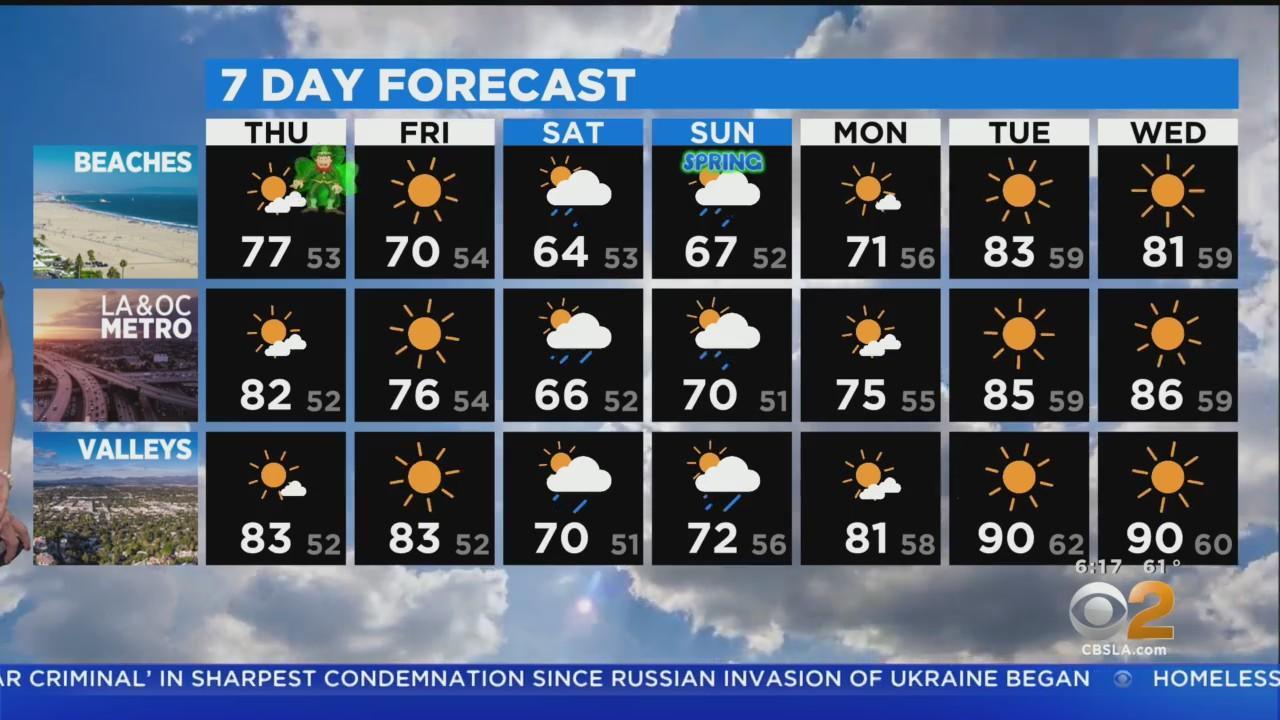
Temperatures could climb well past 90 degrees and potentially reach triple digits in parts of the Inland Empire.
A KCAL News Investigation has discovered dozens of parcels of lands in the Palisades Fire zone that presented fire danger due to overgrown brush, a problem that firefighters had been trying to fix for years.

A KCAL News Investigation has discovered dozens of parcels of lands in the Palisades Fire zone that presented fire danger due to overgrown brush, a problem that firefighters had been trying to fix for years. Ross Palombo reports.

A Southern California lawmaker is calling for a state audit of LAUSD after a lawsuit claims it defrauded taxpayers of millions of dollars in funding.

A Southern California lawmaker is calling for a state audit of LAUSD after a lawsuit claims it defrauded taxpayers of millions of dollars in funding.
An investigation has found that hundreds of fire hydrants spanning throughout Los Angeles may be in need of repair despite being flagged by firefighters for maintenance as far back as a year ago. Ross Palombo reports.
The legal action by the Department of Homeland Security centers around California's Cash Assistance Program for Immigrants.
"We are going to pay the lowest price there is in the world," President Trump said Monday.

Randy Kraft, who has been dubbed the "Scorecard Killer," is the only person under investigation for the 1980 killing, Oregon police said.
New Orleans Saints veteran starting quarterback Derek Carr said he decided to retire because of an injury in his right shoulder.

The quake hit around 9 a.m. local time, about 13 miles from Greenback, Tennessee, which is about 30 miles south of Knoxville, the U.S. Geological Survey said.
The state is releasing a model ordinance that cities can use as a basis for their own local anti-encampment ordinances.
The legal action by the Department of Homeland Security centers around California's Cash Assistance Program for Immigrants.
The White House says the U.S. and China have agreed to suspend for 90 days most of the tariffs imposed against each other over the last couple months.
"We are going to pay the lowest price there is in the world," President Trump said Monday.

On Monday, President Trump said Qatar is "giving us a gift" and "I could be a stupid person and say, oh no, we don't want a free plane."

Lawmakers in California are expected to consider a bill that would allow cities to designate so-called "hospitality zones" where bars and restaurants can serve alcohol until 4 a.m.

A proposal brought on by Northern California lawmaker is seeking to improve the process of cleaning up abandoned shopping carts in the state, which are often a source of blight on streets and waterways.

Grocery giant Albertsons will pay nearly $4 million to settle a lawsuit accusing it of overcharging customers at hundreds of Albertsons, Safeway and Vons supermarkets.

A federal judge has blocked a new California law allowing any person to sue for damages over election deepfakes.

Californians with iPhones and Apple Watches will now be able to store digital versions of their driver's licenses and identification cards on their devices, state officials announced.

Some of the free supplies being provided include at-home COVID-19 test kits, condoms, fentanyl test strips and naloxone.

A Los Angeles County resident tested positive for measles after traveling to Texas, according to the Department of Public Health.

California officials said bird flu testing has not stopped, despite social media rumors.

Orange County health officials on Wednesday warned the public after a bat that was found at a park last week tested positive for rabies.

The move will ensure coverage through June for 15 million people, including immigrants, who receive health care via the program.

California is filing a lawsuit to challenge President Donald Trump's tariffs, Democratic Gov. Gavin Newsom announced.

At an Oakland hearing Tuesday, attorneys for State Farm Insurance made their case for an emergency rate hike that could impact insurance rates for millions of Californians.
Lawmakers in California are expected to consider a bill that would allow cities to designate so-called "hospitality zones" where bars and restaurants can serve alcohol until 4 a.m.

Fifty women business owners impacted by the Eaton Fire will receive recovery grants of up to $25,000 from Paris Hilton's nonprofit 11:11 Media Impact and GoFundMe.

After winning the World Series and his third league MVP award, the Los Angeles Dodgers star now has the world's most popular Major League Baseball jersey.
Matthew Lugo got his first major league hit on an RBI triple in the fourth inning, and Jo Adell homered in the Los Angeles Angels' 5-2 victory over the Baltimore Orioles.
Corbin Burnes threw seven scoreless innings, Eugenio Suarez hit his 12th homer of the season and the Arizona Diamondbacks beat the Los Angeles Dodgers 3-0 on Saturday night.
The Red Bulls beat the Galaxy 7-0 on Saturday night to extend the defending MLS Cup champions' winless skid.
Mike Trout intends to resume running next week as the Los Angeles Angels slugger ramps up his recovery from a bone bruise in his left knee.
Angel City defender Savy King was hospitalized in stable condition a day after she was stretchered off the field because of what's being called a "medical event" during the National Women's Soccer League team's match against the Utah Royals.

A spokesperson for Taylor Swift said the subpoena is being used "to draw public interest by creating tabloid clickbait."

Actor Michael Pitt was arrested Friday at his home in Brooklyn on nine state counts. His lawyers deny the allegations.

Kamala Harris made an appearance at the 2025 Met Gala on Monday, days after her anticipated return to the public stage where she delivered her first major speech since losing the 2024 presidential election.

Rihanna and A$AP Rocky are expecting their third child, the rapper confirmed on Sunday at the Met Gala.

Ticket prices to the 2025 Met Gala run more than the average down payment on a house — if you can snag an invite.

Annie Ilonzeh talks about her character, and what to expect for the Season 8 finale, and possible end of the show.
Opening statements are underway as Sean “Diddy” Combs stands trial on federal charges in New York City.
Marcos Gaitan celebrated his 96th birthday with teammates at a Thousand Oaks soccer field.
The reverend said Pope Leo XIV has always been very talented, has good administration, and knows how to enjoy life.
Police are searching for the deadly hit-and-run driver of a red Tacoma truck who crashed into pedestrians just before midnight in Westlake.

The Franklin Fire in Malibu quickly grew overnight and threatened several homes. Evacuation orders were issued and Pepperdine University instructed students to shelter in place.

Several people have been injured and multiple homes burned after the Mountain Fire broke out Wednesday morning in Ventura County, burning over 10,000 acres within hours.

KCAL News Anchor and three-time Emmy award-winning journalist Chauncy Glover has died.

Los Angeles comes out to celebrate the Boys in Blue two days after winning the 2024 World Series.

The Los Angeles Dodgers are World Series champions after defeating the New York Yankees in game 5.